Listen to this article
Repiping is one of the bigger plumbing jobs a homeowner can face — but for many older Auckland homes, it is also one of the most transformative. I am Pete at Water & Gas Worx — PGDB-registered with 17+ years on Auckland tools — and I have repiped enough villas, bungalows, and 70s weatherboards to know when the pipes are the problem and when something else is. If your home was built before the 1970s and still has original plumbing, it may be time to have an honest conversation about what is running through your walls.
Quick answer: The five key signs you need to repipe an Auckland home are persistent low water pressure, rust-coloured water at the taps, recurring leaks in different parts of the house, visible corrosion on accessible pipework, and a build date before 1970 with no record of the plumbing being replaced. Most full home repipes take 2 to 4 days, swap original galvanised steel for copper or cross-linked polyethylene (PEX), and are best timed alongside a renovation. Water & Gas Worx provides a fixed quote after a site visit — labour is $155+GST first hour, $100+GST per hour after.
What Are Galvanised Steel Pipes?
Galvanised steel pipes were the standard for water supply in New Zealand homes from the early 1900s through to the 1960s and 70s. They are coated in zinc to resist corrosion — but that coating does not last forever. Once it breaks down, the steel begins to corrode from the inside out.
From the outside, these pipes can look perfectly fine. Inside, they may be heavily scaled and partially blocked. That is the problem.
Signs Your Home May Need Repiping
Persistent Low Water Pressure
This is the most common symptom. As galvanised pipes corrode internally, they build up scale and rust that narrows the diameter of the pipe. What was originally a 20mm pipe may effectively be half that size after decades of corrosion. The result is weak pressure throughout the house that gradually worsens over years.
If your pressure has been declining slowly and a plumber cannot find another cause (toby valve, pressure reducing valve, council supply), the pipes themselves are the likely culprit.
Rust-Coloured or Discoloured Water
Brown or orange-tinged water from the hot taps — or the cold taps in severe cases — is a sign of active pipe corrosion. You may only notice it after pipes have not been used for a while, such as first thing in the morning.
This is not just an aesthetic issue. Rust particles in your water supply affect the taste and can damage appliances like dishwashers and washing machines.
Recurring Leaks
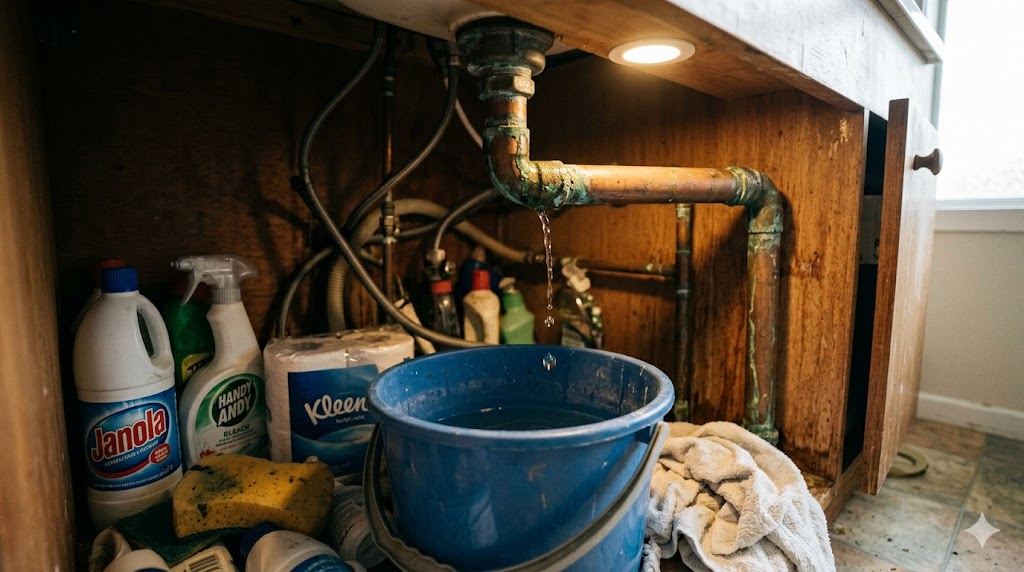
Galvanised pipes do not fail all at once. They corrode through in the weakest spots first — which is often at joints and fittings. If you are having leaks repaired regularly in different parts of the house, you are playing whack-a-mole with a pipe system that is failing throughout. Professional leak detection can confirm whether the issue is systemic. Repiping fixes the root cause rather than patching individual leaks.
Visible Corrosion
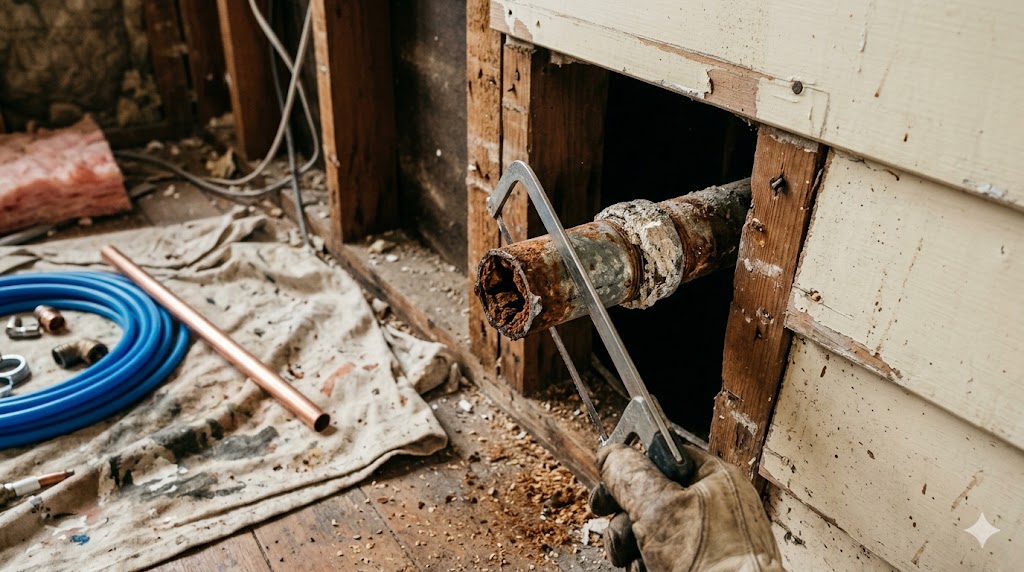
Where pipes are accessible — under the house, in the ceiling, or in wall cavities during a renovation — look for orange rust deposits, pitting on the pipe surface, or white mineral build-up at joints. Any of these indicate advanced corrosion.
Your Home Was Built Before 1970
If your home is over 50 years old and you have no record of the plumbing being replaced, there is a reasonable chance the original pipes are still in place. A plumber can assess the condition and advise whether replacement is needed now or coming soon.
What Does Repiping Involve?
Repiping replaces all the old supply pipes throughout the house with modern material — typically copper or cross-linked polyethylene (PEX). The process involves:
- Accessing pipe runs through walls, ceiling, and sub-floor
- Removing old galvanised pipes and fittings
- Installing new pipes and connections throughout
- Reinstating walls and surfaces where access was required
- Connecting to all fixtures and testing the system
Repiping is best done when other work is happening — during a bathroom renovation when walls are already open. If walls need to be opened specifically for repiping, there will be plastering and repainting required afterwards.
Copper vs PEX
Both are excellent modern options:
- Copper is the traditional replacement material — long lasting, proven, and compatible with all fittings. Higher material cost but a known quantity.
- PEX (cross-linked polyethylene) is flexible, which means fewer joints and faster installation. It is increasingly common and has a strong track record in NZ. Lower material cost and can be run in longer continuous lengths.
Your plumber can advise which is most appropriate for your home.
What Does Repiping Cost?
Repipe cost depends on the size of the house, access under the floor and through the ceiling, and how much wall and ceiling reinstatement is needed afterwards. The only honest way to give you a number is a site visit and assessment — every house is different, and we are not going to invent a figure off a phone call.
Our labour rate is $155+GST for the first hour and $100+GST per hour after, with all pricing fixed and quoted upfront before work starts. Materials, fittings, and any plastering or painting work are wrapped into the fixed quote. See our pricing page for full rate details.
Is It Worth It?
In almost all cases, yes. A full repipe restores proper water pressure, eliminates rusty water, ends the cycle of recurring leaks, and adds to the value and insurability of the property. It is a permanent fix, not another patch. Left too long, a failing pipe can become a burst pipe — causing thousands in water damage.
Think Your Home Might Need Repiping?
Water and Gas Worx carries out full home repiping across Auckland. We are registered with the Plumbers, Gasfitters and Drainlayers Board and will assess your pipes honestly and give you a clear recommendation — not just tell you what you want to hear.
Call 0800 322 322 for an assessment or email service@wgw.co.nz
Frequently Asked Questions
How long does a full home repipe take?
Most standard 3-bedroom homes take 2 to 4 days depending on access and complexity. Homes with easier access under the floor or through the ceiling can be faster. We plan the job to minimise disruption and restore water each day.
Will I be without water during a repipe?
There will be periods during the day when water is off while connections are being made. We aim to restore water at the end of each working day so you have supply overnight. We will let you know the plan before work starts.
Is it better to repipe with copper or PEX?
Both are excellent choices. Copper is proven and durable. PEX is flexible, faster to install, and slightly cheaper. We can discuss which suits your home best during the assessment — there is no one-size-fits-all answer.
How much does repiping cost in Auckland?
Repipe cost depends entirely on house size, access, and how much reinstatement is needed. We do not give phone-quote figures because they are usually wrong. Labour is $155+GST first hour, $100+GST per hour after. We provide a full fixed quote after a site visit so you know the total cost before any work starts.