Listen to this article
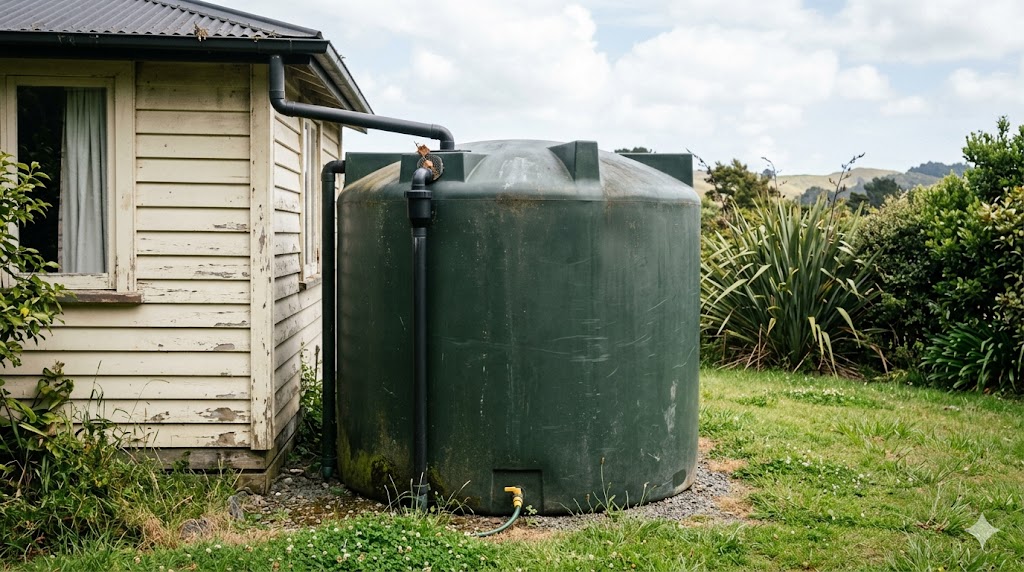
While most Auckland properties are on the Watercare reticulated supply, tank water systems are common on lifestyle blocks, rural properties, and some coastal areas around the region. They are also increasingly being considered as a supplementary supply for garden irrigation and toilet flushing. Here is what you need to know.
Types of Tank Water Systems
Full Rainwater Collection (Primary Supply)
Properties not connected to the Watercare network rely entirely on roof-collected rainwater stored in tanks. This includes lifestyle blocks, rural properties, and some coastal and island communities around Auckland.
For this to work as a primary drinking water supply, the system needs to be properly designed with adequate tank capacity, correct filtration and treatment, and regular maintenance.
Supplementary Rainwater Collection
Some urban Auckland properties collect rainwater for garden irrigation, car washing, or toilet flushing. This reduces demand on the mains supply and lowers water bills. A simpler setup is required as the water does not need to meet drinking water standards.
Bore Water
Some rural Auckland properties have bores — groundwater sources accessed by drilling. Bore water quality varies significantly by location and must be tested before use as drinking water.
Key Components of a Tank Water System
Collection and Storage
- Roof catchment: Roof area and material affect water quality and volume. Metal roofs are generally better than painted or treated timber. First-flush diverters remove the first contaminated flush of rain before it enters the tank.
- Tank material: Polyethylene (poly) tanks are most common in NZ. They should be food-grade and UV-stabilised. Tank size depends on household demand and local rainfall — common sizes range from 10,000 to 30,000 litres.
- Tank position and overflow: The tank must be positioned and plumbed to overflow safely and not cause erosion or flooding.
Pump System
Unlike mains water which is pressurised at the street, tank water must be pumped to create pressure. A pressure pump (or pressure vessel system) is installed to deliver water at adequate pressure throughout the home.
Pump sizing matters — an undersized pump causes low pressure, particularly when multiple outlets run simultaneously. A plumber can size and install the right pump for your household demand.
Filtration and Treatment
For drinking water use, rainwater must be filtered and treated:
- Sediment filter: Removes particles and debris — typically the first stage
- Carbon filter: Removes organic compounds and improves taste
- UV sterilisation: Kills bacteria and viruses — essential for tank water used for drinking and cooking
The specific treatment required depends on your roof material, surrounding environment (trees, birds, proximity to farming), and intended use.
Water Quality and Testing
Tank water — even with filtration — should be tested periodically for bacterial contamination. This is particularly important:
- When the system is first commissioned
- After any tank maintenance, cleaning, or system modification
- If anyone in the household has a weakened immune system
- Annually as a general precaution
Water testing can be arranged through accredited laboratories in Auckland. Your plumber can advise on what to test for based on your system and location.
Connecting Tank Water to the House
Plumbing a tank water system into a house involves:
- Running supply pipes from the tank and pump to the house
- Installing filtration and UV treatment in line
- Connecting to the internal plumbing distribution system
- Installing a mains bypass if a mains connection is also present (must be done correctly to prevent cross-contamination)
Important: If your property has both mains water and tank water, the systems must be physically separated with an approved backflow prevention device. Cross-connecting tank water to the Watercare network is illegal and can contaminate the public supply.
Maintenance of Tank Water Systems
- Clean the tank: Tanks should be inspected and cleaned every 3 to 5 years to remove sediment build-up
- Replace filters: Sediment and carbon filters need replacement every 6 to 12 months depending on usage
- Check UV lamp: UV lamps have a rated lifespan (typically 12 months) and must be replaced on schedule — they continue to glow after the effective sterilisation period ends
- Service the pump: Annual pump service extends lifespan
- Clear gutters and downpipes: The catchment system needs to be clean — debris in gutters affects water quality
If you notice low pressure or inconsistent supply from your tank system, it may be a pump issue, a water leak in the supply line, or a blocked drain affecting overflow. Have it checked before the problem worsens.
Hot Water on Tank Water Systems
Your hot water system needs adequate pressure to function properly. Low-pressure tank supplies may require a low-pressure-rated cylinder or a mains-pressure conversion. Gas continuous flow units generally require a minimum flow rate — your gasfitter can advise whether your tank system meets the requirements.
Tank Water Plumbing in Auckland
Water and Gas Worx installs, services, and repairs tank water systems across Auckland and the surrounding region. We are registered with the Plumbers, Gasfitters and Drainlayers Board. We can design the right system for your property, install it to code, and set you up with a maintenance plan.
Call 0800 322 322 or email service@wgw.co.nz
Frequently Asked Questions
Is rainwater safe to drink?
With proper filtration and UV sterilisation, roof-collected rainwater is safe to drink. The key is maintaining the system — replacing filters every 6 to 12 months, replacing the UV lamp annually, and keeping gutters and the roof catchment clean. We recommend periodic water testing as an extra precaution.
How big a tank do I need for my household?
For a primary supply (no mains connection), a general guide is 5,000 to 10,000 litres per person in the household. For Auckland, with reasonable rainfall, a 3-person household typically needs 20,000 to 30,000 litres. For supplementary use (garden and toilets only), 5,000 to 10,000 litres is usually sufficient.
Can I connect a rainwater tank to my existing house plumbing?
Yes, but it must be done correctly. If you also have a mains water connection, the two systems must be physically separated with a backflow prevention device to avoid contaminating the public supply. A licensed plumber must carry out the work to ensure it complies with the Building Code.
How much does it cost to install a tank water system?
Our rate is $155 plus GST for the first hour, then $100 plus GST per hour after that. After-hours is $295 plus GST for the first hour, then $100 plus GST per hour after that. Public holidays are $395 plus GST for the first hour, then $100 plus GST per hour after that. We can quote before starting so you know the cost upfront. The total cost depends on the tank, pump, filtration, and piping required — we provide a full quote after a site visit.