Listen to this article
Not all gas leaks announce themselves with a strong smell. Sometimes the smell leads you straight to the source. Other times, it's hiding in the last place you'd think to look. This job in St Heliers was one of those — a leak inside a wall cavity, right next to the electrical wiring.
The Call
The homeowner had noticed a gas smell in the downstairs lounge area. That's not something you ignore — we headed out to investigate.
What We Found
We started with a manometer test on the gas meter. This measures the gas pressure in the system over time. We found a small but definite pressure drop over 1 to 2 minutes — confirming there was a leak somewhere on the installation.
Next, we used a handheld leak detector to trace the source. The detector picked up a gas signal at the electrical box on the wall. That told us one thing — gas was sitting inside the wall cavity.
Gas accumulating near electrical wiring is a serious safety concern. We needed to find the source.
Opening Up the Wall
We cut an access hole in the gib directly behind the gas meter. Inside the wall, we found the problem — a transition fitting connecting the copper gas pipe to the Rifeng (flexible gas pipe) had been leaking.
The Problem
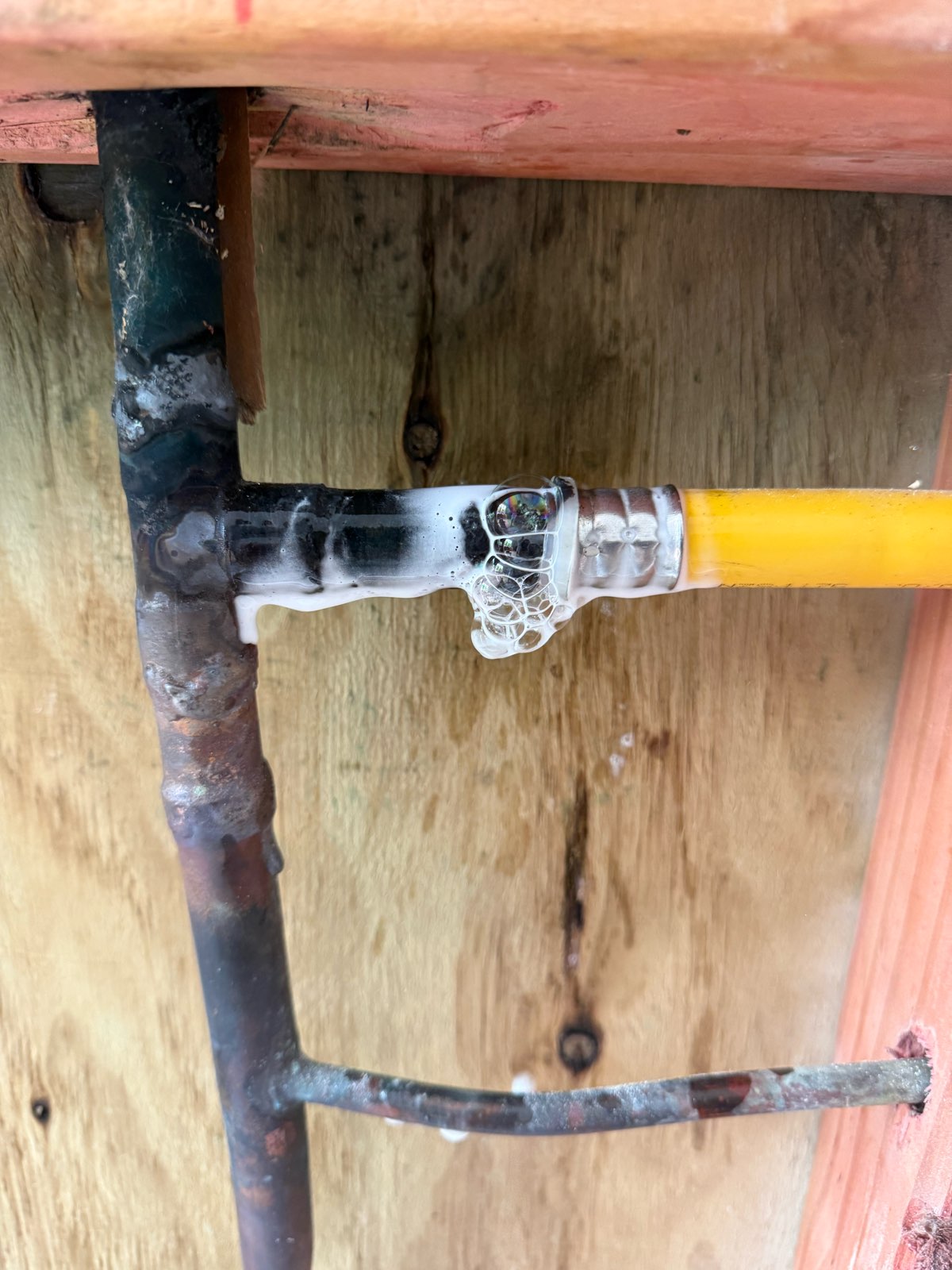
Leak detection fluid confirming gas escaping at the copper-to-Rifeng transition fitting. You can see the bubbles forming where the copper meets the yellow Rifeng pipe.
The Fix
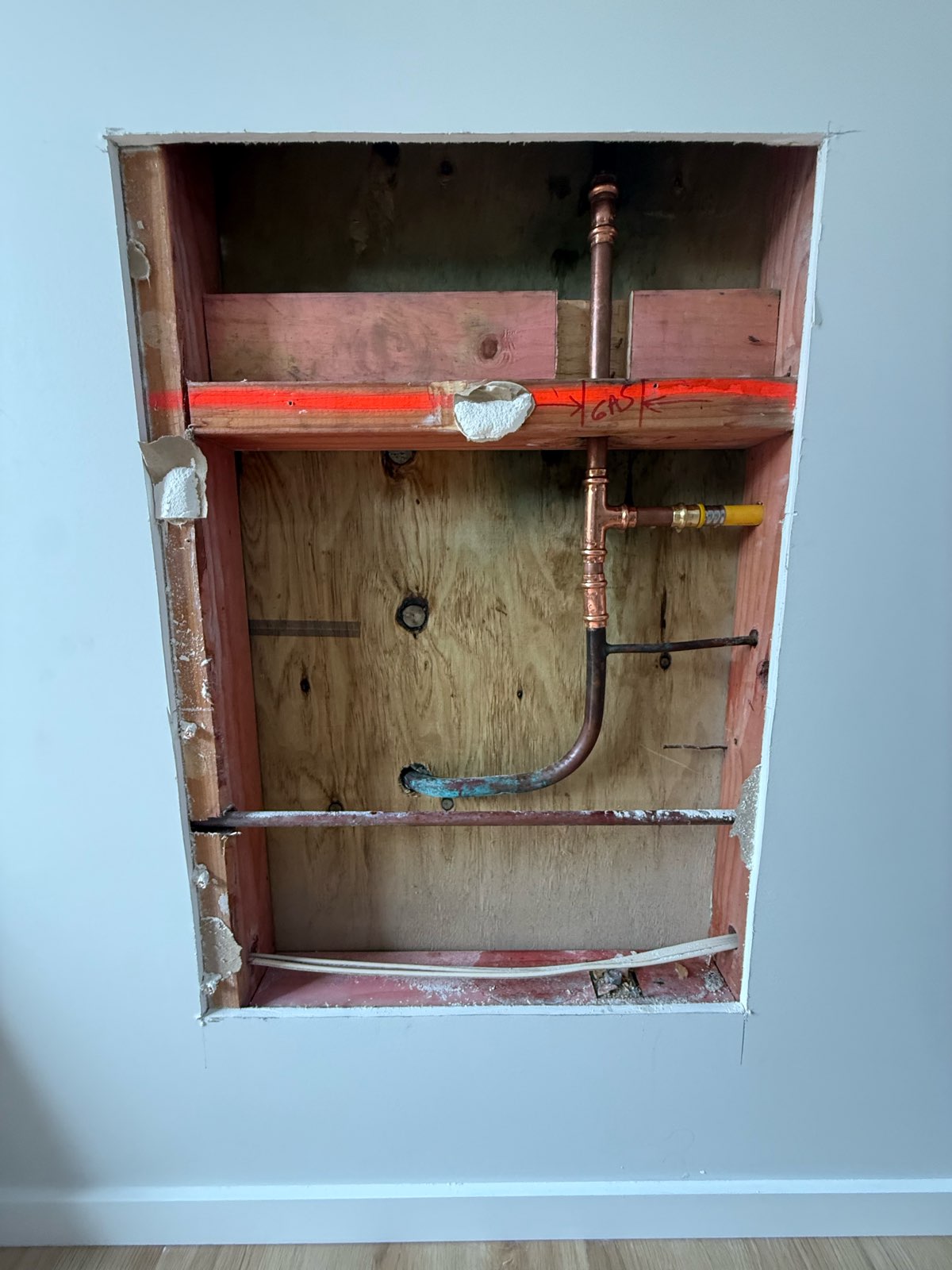
Wall opened up, faulty fitting removed, new copper pipe section installed and connected to the Rifeng gas line.
How We Fixed It
Isolate the gas supply
Turned off the gas at the meter to make the area safe before any work.
Remove the faulty fitting
Cut out the failed transition fitting that was connecting the copper to the Rifeng gas pipe.
Install new copper section
Picked up fittings from the supplier and installed a new section of copper gas pipe, reconnecting it to the existing Rifeng pipework with proper fittings.
Test and certify
Reinstated the gas supply and ran a full pressure test. No further drop — gas tight. Issued the required gas safety certificate.
Why This Matters
This is the kind of leak that can go undetected for a long time. The fitting was failing slowly — gas was pooling inside the wall cavity near the electrical box. The homeowner picked up on the smell downstairs, but without a manometer test and leak detector, the actual source inside the wall would have been almost impossible to find.
A few things worth knowing:
- Transition fittings can fail over time — especially where copper connects to flexible gas pipe. Movement, vibration, and age all contribute.
- Gas inside wall cavities is dangerous — it can accumulate near ignition sources like electrical wiring and switches.
- A manometer test pinpoints what your nose can't — you might smell gas in the room, but finding the exact source inside a wall requires a pressure test and leak detector.
- Only a certified gasfitter should work on gas lines — it's illegal in New Zealand for anyone else to do gas work, as required by the Plumbers, Gasfitters and Drainlayers Board.
Think You Might Have a Gas Leak?
If you smell gas, follow our guide on what to do if you smell gas. If you're not sure but something feels off — a hissing sound near a pipe, a higher-than-normal gas bill, or dead vegetation near a gas line — get it checked. A manometer test takes minutes and could prevent something serious.
We're a certified gasfitter covering all of Auckland. Call 0800 322 322.