Listen to this article
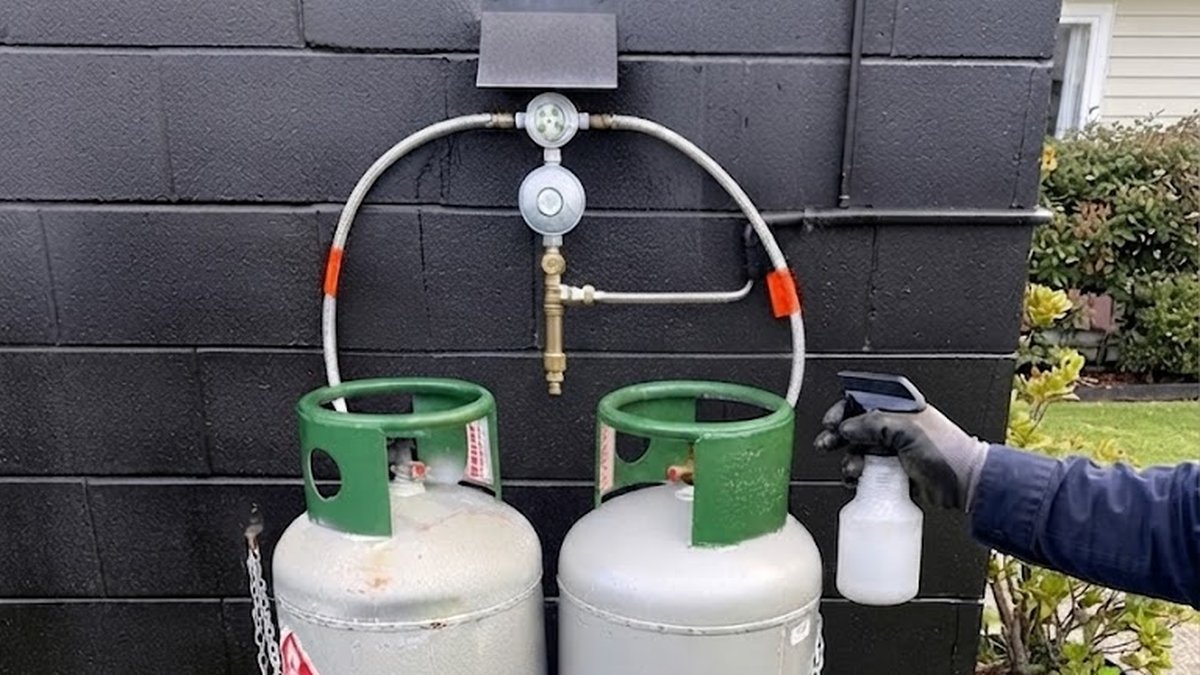
It usually starts with a note on your door or a quick knock from the LPG delivery driver. They've swapped your 45kg bottles, done their routine leak check, and found one of the flexible hoses connecting your bottles is leaking. So they've turned the bottle valve off, tagged it, and told you to "get a gasfitter to look at it" — and that's it. They're not allowed to recommend anyone, so you're left searching online wondering how urgent this is and what it's going to cost. I'm Pete from Water & Gas Worx — a PGDB-registered gasfitter with 17+ years on Auckland tools — and this is one of the most common call-outs we get. Here's exactly what's going on and how to get your gas back on.
Quick answer: If your LPG delivery driver has found a leaking gas bottle hose (called a pigtail) and shut your bottles off, a PGDB-registered gasfitter must replace it — it's restricted gasfitting work in New Zealand. Water & Gas Worx replaces both pigtails on a standard 45kg twin-bottle setup Auckland-wide for $365+GST fixed, including a regulator check, gas tightness test and gas certificate — usually the same day. Call 0800 322 322.
Why the delivery driver shut your gas off
Every time your LPG supplier swaps a 45kg bottle, the driver is required to do a basic leak check on the connections before they leave. If they see, smell or hear a leak — often a faint hiss or bubbling when they test the fitting — they can't legally leave it connected. So they close the bottle valve, tag the setup, and note it on your account.
Here's the part that catches most homeowners out: the driver can't fix it, and they can't recommend a gasfitter either. Delivery drivers aren't registered gasfitters, and the big suppliers don't allow their staff to favour one gasfitting company over another. Their standard advice is simply "search online for a local gasfitter" — which is probably how you ended up here.
The good news: this is a small, well-defined job. It doesn't mean your gas system is failing, and it doesn't need a quote or a site visit first.
What the leaking hose actually is
The flexible hoses connecting each gas bottle to your regulator are called pigtails. On a standard two-bottle setup, each 45kg bottle has its own pigtail running to a changeover valve or regulator mounted on the wall. That short length of hose carries gas at full bottle pressure — the regulator hasn't stepped it down yet — which is exactly why a perished pigtail matters more than a small leak somewhere further down the line.
Pigtails live outside in the weather. Over the years the rubber degrades from UV exposure, temperature cycling and simple age, and the constant flexing every time bottles are swapped speeds that up. Cracked, hardened or perished pigtails are one of the most common faults found on Auckland LPG installations — most have a date stamp on them, and as a rule of thumb they should be replaced around the ten-year mark, or immediately if they show any cracking.
Is it dangerous?
With the bottle valve closed, no. The driver has already isolated the leak, which is why they're required to shut it off rather than leave it. What you shouldn't do is turn the bottle back on to "get by" in the meantime — even if only one of your two bottles is tagged. A leaking pigtail vents raw LPG right next to your house, and LPG is heavier than air, so it pools low around foundations and vents rather than dispersing. If you ever smell gas around the bottles when they're switched on, treat it seriously — our guide on what to do if you smell gas covers the steps.
Why you can't just replace the hose yourself
You'll find pigtails for sale online and at trade merchants, but replacing one on a fixed home installation isn't a DIY job — and not just as a matter of good practice. Under the Plumbers, Gasfitters, and Drainlayers Act 2006, gasfitting on a fixed LPG installation is restricted work that must be carried out by an authorised gasfitter, and the installation has to comply with AS/NZS 5601.1, the gas installations standard. When the work is done, you should receive a gas certificate as required under the Gas (Safety and Measurement) Regulations 2010 — that's your proof the work was done by a registered gasfitter and tested safe, and it matters for insurance and for rental compliance records. We've written more about gas certificates and when you need one.
There's also a practical reason: a leaking pigtail is sometimes a symptom rather than the whole story. The regulator or changeover valve on older setups can be nearing the end of its life too, and a gasfitter will check it while the system is open rather than bolting a new hose onto tired gear.
What replacement involves — and what it costs
This is a fixed-price small job for us. Here's what happens on the visit:
- Both pigtails replaced — not just the leaking one. They're the same age, and if one has perished the other is close behind.
- Regulator and changeover valve checked while the system is open.
- Full gas tightness test on completion to confirm the whole installation is sound.
- Gas certificate issued for the work.
- Bottles turned back on and appliances re-lit and checked.
The price is $365+GST fixed for a standard 45kg twin-bottle setup, with everything above included — no quote, no site visit, no hourly surprises. You can book LPG pigtail replacement online in about a minute, and we cover 70+ Auckland suburbs with same-day service on most bookings. If your gas has been off and you're without hot water or cooking, call 0800 322 322 and we'll prioritise it.
How to stop it happening again
Pigtails are a wear item — they will eventually need replacing again, but you can get ahead of it:
- Glance at the hoses each time your bottles are swapped. Cracking, stiffness or perishing at the bends means they're due.
- Check the date stamp. Around ten years old, replace them on your terms rather than waiting for a driver to shut you down mid-winter.
- If your regulator is original to an older home, have it checked at the same time as the pigtails — replacing both together avoids a second call-out later.
- Keep the bottle area clear. Vegetation and stored items trap moisture against the fittings and hide problems.
Common questions
Can I turn my gas bottles back on if only one hose is leaking?
No. Even with a two-bottle changeover setup, the leaking pigtail is upstream of the regulator and carries full bottle pressure. The driver tagged and closed it for a reason — leave it off until a registered gasfitter has replaced the hose and tested the system.
Why won't the delivery driver just replace the hose?
Delivery drivers aren't registered gasfitters, so they can't legally do the work, and LPG suppliers don't allow drivers to recommend specific gasfitting companies. That's why their advice is always to search online for a local gasfitter. Replacing pigtails on a fixed installation is restricted work under the Plumbers, Gasfitters, and Drainlayers Act 2006.
How much does LPG pigtail replacement cost in Auckland?
Water & Gas Worx replaces both pigtail hoses on a standard 45kg twin-bottle setup for $365+GST fixed. That includes the new hoses, installation by a PGDB-registered gasfitter, a regulator check, a full gas tightness test and the gas certificate. It can be booked online with no quote or site visit needed, with same-day service available across most of Auckland.
Do I get a gas certificate for the work?
Yes. A gas certificate is issued as required under the Gas (Safety and Measurement) Regulations 2010. Keep it with your property records — it's your proof the work was done by a registered gasfitter and tested safe, and it's useful for insurance and rental compliance.
How long do LPG pigtail hoses last?
As a rule of thumb, around ten years. Most pigtails carry a date stamp, and because they live outdoors in UV and weather, the rubber perishes over time. Replace them at the ten-year mark or as soon as they show cracking or stiffness — and always replace both at once on a twin-bottle setup.